
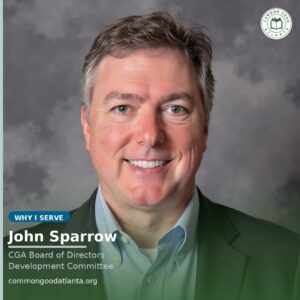
Why I Serve – John Sparrow
How did you get involved with Common Good Atlanta?
Sarah Higinbotham — one of CGA’s two co-founders — and I met as classmates in Leadership Atlanta in 2016. Once I met Sarah, saw her infectious enthusiasm, and learned more about the organization’s work, I found the mission incredibly compelling and was eager to help.
It was very easy for me to see the long-term value of leaning into an initiative that helps provide education and enrichment opportunities for system-impacted individuals who are motivated to learn and grow. Common Good Atlanta approaches this work with sincerity, candor, and without judgment or preconceptions. Given that dignity and respect for the students are a central priority — and our faculty and staff embodies this in every interaction — it is hard not to be drawn to supporting the efforts of CGA.
Is there a specific experience that is particularly memorable for you?
I spent ten years in executive search, and some years ago, Sarah asked if I might have a few minutes to help a CGA alum with his resume. I agreed — and during that conversation, I quickly came to understand the Sisyphean journey that many system-impacted individuals face in gaining meaningful employment.
In his case, he had spent his entire adult life incarcerated, yet had to craft a resume that would be compelling and engage interest. This was a very interesting exercise and humbled us both. Through some meaningful conversation, we were able to come up with ideas for how to memorialize his growth and leadership experience — honest, and demonstrating tenacity and the ability to solve complex problems.
While I was glad we came up with ideas together, he shared that he was just surprised and humbled that a person who wore a suit and tie to work every day took 90 minutes to meet with him and help him. This was eye-opening for me — to say the least.
Why should others support CGA’s mission?
While I respect every person’s sense of what speaks to them, for me, I would ask people to share why they wouldn’t support this work. Individuals are exiting the correctional environment every day and opportunities for them are complicated and limited.
For me, this is a simple and binary proposition — we can either lean in and help folks who want to make the most of a second chance, or ignore the realities they face upon re-entry and seem surprised when people struggle. These individuals are a part of our community, and the more we help them learn and find constructive paths to growth, the more we all benefit from their success.